Liturgical Intelligence: Breath I
A Good Light
Alex Nutting Jun 16, 2026


The warning labels on the box came in twelve languages, none of which were particularly helpful. There were no words at all on the instruction manual, just small diagrams of a cheerful man in three stages of accomplishment, holding things I had not yet located in the cardboard. He was enthusiastically pointing at holes I could not yet find, which were soon to be filled by plastic dowels and screw heads requiring the six-sided hex wrench, which was also buried somewhere in a plastic bag inside the box. My son watched from his high chair with the detached interest of someone who has never assembled anything, but finds the whole enterprise deeply suspicious. He would occasionally contribute a babble which I was too absorbed in cam locks and drawer roller arms to interpret correctly. I had decided the table was the priority for that morning. It needed to be built before we could eat off something other than the floor, which seemed like a reasonable order of operations. The peach puree arrived from the tray above shortly thereafter and covered the instruction manual with a thick sludge.
The smallest voice in the room had been offering fair warning.
I had not been listening.
We had unloaded our packed SUV days before, with the car seats in the back wedged in-between enough bags of clothes to suggest we had not entirely committed to the idea of staying anywhere permanently. We were not quite sure, this time either, how long we would be here. The distance from where we had come from was not something I could measure on a map.
This new table I was building was birch and compressed particle board, just over a hundred pounds of it, and it smelled like the factory it had come from: industrial glue, veneer, sawdust, and that particular sharpness of new furniture that takes weeks to leave a room. Perhaps a lingering hint of formaldehyde. We had abandoned what had once been a proper dining room and converted it into a playroom stacked with bricks, blocks, and homeschooling supplies. The two little leaves folded up so the table could fit into the breakfast nook near the kitchen, which was now serving as our full-time dining room.
I sat on the floor with the Allen wrench and a wet wipe that was no longer white, and thought about my grandfather’s kitchen table.
It was solid oak and so heavy that it probably could have made the floor sag in that old farmhouse. It had a rusted undercarriage with a metal crank and sliding wood blocks that locked into place when you pulled out the extra leaf to make it longer. Several times a year it would be transformed from its usual round shape into something more oblong, capable of receiving the cousins at Thanksgiving and Easter, when the smaller folding table would also be deployed in the corner. The chairs had oak leaves carved into their backs and small wooden dowels near the bottom that served as footrests for children. These footrests I had used until I was no longer a child and then kept using anyway, quietly, because old habits do not leave the body easily.
My grandfather sat at the twelve o’clock position, which happened to be closest to the back door and gave him a clean view through the main picture window toward the gravel road out front. He could see the dust rising long before a neighbor’s truck was visible, giving him time to decide whether or not he wanted to be available. My grandmother sat to his immediate right because that put her closest to the stove, where she had spent decades producing food in quantities that assumed someone unexpected would always be coming. She always had more ready than she thought she would need, because the last thing you wanted was for someone to go away hungry. Across from him sat the oldest male child, and everyone else arranged themselves according to a hierarchy that was never stated and never needed to be. You learned it through one sideways glance from my grandmother, once, and that was sufficient instruction for a life on the farm.
The table had been scarred by decades of card games and hot pans set down without thinking and children doing homework with pencils pressed too hard. The veneer at the center was bubbled, probably from the old kerosene lantern that brought light to the room on stormy evenings. It had been refinished several times, the wood always returning with that warmth of something that has been cared for rather than merely replaced. Outside the windows, my grandfather had hung two bird feeders, maybe three, which he had maintained so faithfully and for so long that the birds simply came every year without needing to discover the place again. Cardinals and wrens and goldfinches in the ordinary rotation, and occasionally hummingbirds, orioles, indigo buntings, and bluebirds. Birds that need open space and wild places to roam knew instinctively where it could still be found.
It was not the wood itself I missed, sitting there on the floor with the Allen wrench. It was not the object, not the table as an heirloom possession. It was the shape of the relationships beneath it, and the way that shape had quietly given way over time into something altogether different. I knew I could not take that old table with me. What I had not expected was to find myself missing not the furniture but the community, the family, the whole structure of daily life that had gathered around it. The trouble with replacing things is that it requires you to have seen them first.
The table I was building would not outlast the decade. I was fairly certain of this already, somewhere around the forty-fifth page of the instruction manual.
We had moved often enough in the years before that I had stopped keeping a precise count. We had lived in this town once before, right after college, and sold the house and furniture thinking we would not be back. Now we were in a different neighborhood, a different phase of life, surrounded by people who were mostly newcomers themselves.
There had been a stretch in New England when we would make the trip down to Old North Church in Boston on a Sunday morning, occasionally, when I was in town and not on one of my many work trips. We were drawn by the allure of the north end, by something we could not quite name at the time. The pews there were not benches. They were enclosed boxes built to hold warmth, inherited across generations. The difference between sitting in one of those and sitting in a folding chair arranged inside of a multipurpose sanctuary mega-room is not really about age. It is about what is already holding a shape before you arrive; before you have decided anything, like whether you will return, and before you have earned the right to belong. One is ready to receive you. The other waits for you to choose.
I had been thinking about that difference for years without knowing I was thinking about it. Then the pandemic came, and the question stopped being theoretical.
Daycares closed, churches went online only, the ordinary architecture of a week dismantled and replaced with something that was technically the same days in the same order, but felt nothing like time as I had previously understood it. Our kitchen table during those months held coloring books, grocery lists on the backs of old envelopes, and the dishwasher cycling behind someone little who had begun crying over something that no longer mattered. Everything blurred together into a general condition of endurance we told ourselves was temporary because we needed to believe that. My grandfather’s oak table felt a world away from the one I was now assembling, all on my own.
Likewise, we did not mean to leave the church. We simply filled the space with other things. Sunday mornings slipped away into errands and chores, the kind of ordinary busyness that is not rebellion but slowly reshapes your week. Then general inertia, and the particular exhaustion of getting everyone dressed and into seats before the opening hymn. The ache that followed was not dramatic. It felt more like fatigue, or a quiet hunger for simplicity, the way you stop hearing a neighbor’s dog after long enough or the lawnmower at precisely 7:01 in the morning kicking over, until one day the silence where that noise once was sounds strange. But it lingered.
Three children under seven, expensive daycare, and a job that had kept me on the road most of the year… something had to give. When the pandemic ended and we moved, I had also changed vocation. We made the family decision for me to become a stay-at-home dad.
I must admit, being the only man at most playgrounds had its small mercies. I was mostly left alone, which I sometimes told myself was peaceful and sometimes had to admit was just lonely. Our neighborhood in the suburbs where we had settled did not help. We had no friends or relatives within a two-day drive. Our new home was almost like a little isolated monastery, I decided, if monasteries were known for their art time accidents on the wall, splattered puree, and high-pitched squeals of “Dad, she stole my…” As it turned out, that monastery did have a labyrinth, too. Just not the contemplative kind. We never got anything complete, we never got there fast, and we definitely repeated ourselves- usually by me begging for a quiet respite from their cartoons.
The silence I had been looking for was theoretically present somewhere in the architecture. It was hard to locate beneath the maze of art supplies on the floor, the oven timer, the laundry machine finishing its cycle, and the ongoing arbitration over whose stuffed rabbit had gone missing. Arguments over whose book was whose, who had hit whom, and whether that particular hit had been provoked were hourly. Sixty percent of the vocation, I was learning, was peacekeeping. The other forty percent was locating things. I would occasionally attempt to use the bathroom alone, and I would close the door. Four seconds, approximately, would pass. Then, from somewhere down the hall: Daaaaad! Not a question. A summons. With that specific pitch that means the situation has already progressed beyond the point where it could have been resolved without you. Same as the last time.
There were moments in those early days when what I wanted most was a room with no one in it, just enough silence to hear myself think.
I did not get that room. But I kept wanting it.
There was simply more of everything now: more content, more noise, more voices, and underneath all of it, less and less of what I was trying to pass on to them. The house was not alone in this
I began looking for somewhere regular, somewhere my children could grow alongside other children. Somewhere, if I am being honest, that I could too. Which is part of why, when my son was old enough, I started looking into scouting. I wanted him to have something with roots, something carrying the same values I had grown up with, and a place where the things being taught were the kind that lasted.
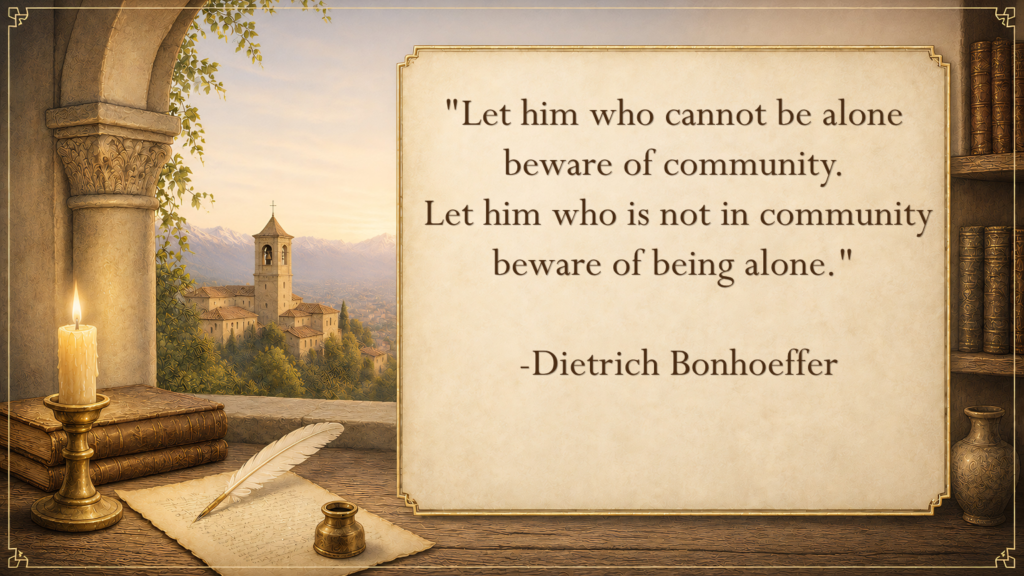
The church found us, more or less. There was a scouting unit that met in the parish hall, our son needed a unit, and the building was close enough to the new house that it solved a logistical problem without requiring any particular commitment. We showed up because it was convenient. Our youngest daughters, baby four having just arrived, still needed to be baptized. The shutdowns had delayed everything. and we were simply working through the list of things that had accumulated.
We were not ready to belong anywhere. We arrived on Sunday mornings with children in varying states of readiness, occasionally missing the opening entirely, sliding into the back pew with the posture of people who had not yet decided whether they were staying, and not yet ready to face the accountability of being regular members.
The liturgy there was old in a way that required something from you, more a kind of physical attention than understanding. The words pulled the body into kneeling, sitting, standing, all while keeping a toddler inside the pew; rescuing dropped water bottles, crayons and sippy cups before they rolled down the aisle.
Stand here. Kneel here. The same words each week, which I had spent enough of my life treating as evidence of staleness to now find, for reasons I could not fully account for, oddly steadying.
The people were kind in that persistent, slightly inconvenient, way that is the only kind of kindness that actually works on people who have not yet decided to receive it. They told us to keep coming back. They recognized something in our particular chaos that was familiar to them from an earlier season of their own lives, and they had come through it still present in the same pews. This struck me as a form of evidence I had not expected to find useful.
The ache did not stop. But it began to have somewhere to be.
I did not yet see these things as a return. I only knew that, for the first time in a long while, I did not have to hold the ache alone.
The first turn through my labyrinth revealed the first rule:
The Strategic Disciple is a reader-supported publication. To receive new posts and support my work, consider becoming a free or paid subscriber.
This is the first Breath of Liturgical Intelligence. The series works best read in order.
Explore the larger project:
TheStrategicDisciple.com — Quiet enough to be felt
LiturgicLabs.studio — Faithful imperfections for the faithfully imperfect
Ko-Fi — The tip jar to keep the coffee press going
© 2026 The Strategic Disciple, LLC. All rights reserved.



One Comment
Comments are closed.