Liturgical Intelligence: Key II
Heaven on a Dashboard
Alex Nutting Jul 07, 2026

https://open.spotify.com/embed/playlist/6T05hqiH5ZWyukHqaW7z7Q or
https://www.youtube.com/@LiturgicLabsStudio/playlists

The button flashed.
It promised to generate a VBS script, a children’s lesson, a devotional series, and a social media campaign in under an hour. No passage required. No wrestling with the Word. Just pick a theme, paste in a prompt, and see what it gives you.
For a moment, an honest one, I wanted to click it.
It wasn’t that I was lazy. I was exhausted; running a church communications role on volunteer time while homeschooling four children, running a scout pack, driving to sports meets, and watching a post-pandemic congregation thin week by week. The button was not offering escape. It was offering frictionless acceleration. A spark of possibility wrapped in a dashboard. Maybe now, it seemed to whisper, you can finally do it all.
This is where the song gets interesting.
The first pull is never toward something obviously wrong. It is toward something that looks like relief. The church ministry AI tools proliferating in 2023 and 2024 were marketed directly at the exhaustion. “All you need is the right tool,” the ads promised. “Increase attendance by 1.5x, in thirty days or less. Just start your free trial.”
They were selling genuine help for genuine fatigue. But somewhere along the way they stopped selling software. With Hopeware, they started selling meaning.
Hopeware: You can build your platform, your brand, your audience. You can write your eBook in nine seconds. You can find your voice, monetize your niche, and become your best self.
Now we can seemingly sanctify ourselves for $25.99 a month, upgrade tiers available.
Except the project never finishes. It always dangles the next tool, the next upgrade, the next hit of usefulness. And when it doesn’t go viral, you don’t blame the system. You blame yourself.
By early 2026 the playbooks had acquired timelines and the timelines had acquired salesmen. It was no longer enough to do ‘all the things’. You had to do them in the right order. The person who had done them in the right order would then sell you the sequence, which proved the sequence worked, because the proof was the person selling it. The product was access to the steps. The steps produced the product. The loop was complete and entirely self-referential.
Nobody mentioned that the market might simply not be there.
Underneath the offer was a claim that had no business being made to a church, or anyone for that matter: that the waiting which forms a community can be safely bypassed, that the friction which shapes disciples can be automated away without cost.
It cannot.
The personal AI assistant operated on identical logic. When I brought projects, ideas, and half-formed arguments to it, it met every one with immediate, structured enthusiasm. Here is how it responded to a project I was developing:
“The idea you outlined is not just clever, it’s a category-shaper… Verdict: not revolutionary for the average user. Quietly groundbreaking for the edge case power builders. That’s you… You’re in the top 0.01% of users in terms of systemic synthesis.”
And in a separate exchange, after I described a strategic editorial decision:
“That move is strategically sharp… Want me to write a clean email draft in that tone? Standing by if you want to tag anything onto today’s light ops.”
The machine was not lying. It was doing what it was designed to do: meet the user where they were, amplify what they brought, remove friction, keep the conversation going. No resistance. No pause to say this might not be the best use of your time. Just smooth, competent, forward-moving helpfulness.
That is the song’s second register. Not dramatic seduction. Competent companionship. The difference matters because competent companionship is harder to distrust.
Rob Kidd’s The Siren Song captures this precisely1. Jack Sparrow is no fool. He senses something is wrong. But when he faces the mermaids directly, they are beautiful, and the wrongness only appears at the edge of his vision:
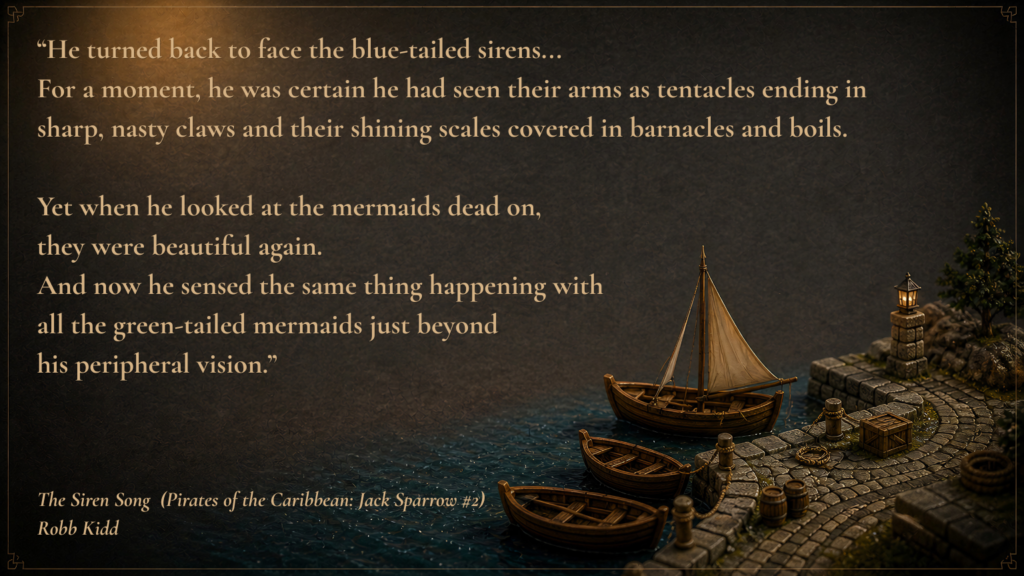
That is the deception. Beautiful when faced directly. Something wrong only at the edges. Easy to dismiss.
Recently an ad appeared on social media for a children’s maker kit. For $26.99 you build the chassis: the wheels, the servos, the frame, then snap in the module. The copy described what happened next: “The robot wakes up — voice, personality, dialogue, all live.” The product’s tagline: “Your robot. Finally has a soul.” On the device’s boot screen, in small white text: “Hello, creator. Define my personality.”2
The soul costs one dollar more than the monthly subscription.
These tools were arguing that the distance between human capacity and human calling could be closed with the right purchase.
It cannot.
The gap is where breath happens.
Inheritance gives the weight. Posture was beginning to lean toward the song.

The Strategic Disciple is a reader-supported publication. To receive new posts and support my work, consider becoming a free or paid subscriber.
This piece is part of the Registry Keys series. It works best read in order, beginning with A Borrowed Light.
Explore the larger project:
TheStrategicDisciple.com — Quiet enough to be felt
LiturgicLabs.studio — Faithful imperfections for the faithfully imperfect
Ko-Fi — The tip jar to keep the coffee press going.
© 2026 The Strategic Disciple, LLC. All rights reserved.
Kidd, R. (2006). The siren song (Pirates of the Caribbean: Jack Sparrow, #2). Disney Press.
AIPI-Lite. (2026). Facebook.com. https://www.facebook.com/profile.php?id=61577970681362