Liturgical Intelligence: Breath II
Heaven Reaches Out
Alex Nutting Jul 21, 2026


We had been back in the pews for a few months before I noticed the gaps. Not on the first Sunday, but gradually, the way you begin to see things when you are paying attention again after a long absence. A children’s program that had run thin. A newsletter that went out sporadically, when it went out at all. A welcome table with a stack of brochures two years out of date, or none at all. Small things, the kind that announce themselves quietly to anyone who shows up with eyes open and a particular disposition toward noticing.
That disposition got me into a lot of trouble.
I mentioned the bulletin to someone. They mentioned that I had mentioned it to someone else. Within a few months I was the volunteer social media coordinator, which in practice meant showing up on Sundays with a phone, reasonable design sense, and seemingly more availability than I had probably accurately disclosed. The role expanded the way roles expand when the person filling them turns out to be capable of more than what was originally described. Newsletters. Social media systems. A welcome brochure that needed designing and a welcome table that needed staffing. A Vacation Bible School that needed a curriculum, and then someone to run the curriculum. Event coordination. Outreach campaigns. Vestry. A part-time staff position that in practice required full-time hours, which I accepted partly because it was meaningful and partly because I was already doing most of it anyway, and someone had correctly observed that this was not sustainable to continue doing for free.
I was not a priest. I did not carry a stole. But I was carrying something.
The labyrinth had expanded from my chaotic monastery in the suburbs to the parish hall, from domestic ‘honey-do’ lists to vestry agendas and diocesan meetings, and the careful navigation of a congregation that had been arranging itself the same way for many years before I arrived with ideas about what it could be. I was an agent of change in an institution that had not requested one. I was a person who instinctively saw what something might become, while others were more attentive to what had already been rooted and sustained. This instinct is a gift in certain rooms and a liability in others, and I was learning, slowly, which room this was.
The congregation was largely seasonal. Half of them were snowbirds who disappeared by April and returned in October, which meant the summer months felt like maintaining a fire with half the wood gone. I would stand in that half-empty room on a July Sunday and feel the specific weight of something I could not quite name. Attendance slipping. Programs thinning. Volunteers stretched across too many roles to fill any of them well. The distance between what the church could be and what it currently had the resources to sustain had collapsed, and I was standing in the middle of the divide, trying to hold both sides together with newsletters and social media campaigns, and a level of personal investment that was not, it turned out, sustainable.
I was not taking care of myself because I was too busy taking care of everything else. The children still needed raising. The marriage still needed tending. The homeschool curriculum still required patience I sometimes did not have. And underneath all of it, the church’s needs had become indistinguishable from my own vocation in a way that was neither entirely healthy nor something I had the clarity to see clearly from inside it. Somewhere along the way, usefulness had begun to feel enough like belonging that I stopped noticing the difference.
Eventually my heart made the clarity unavoidable. Racing. Palpitations. An emergency room where they ran the checklist and found nothing except the general condition of someone who had been running a deficit long enough for the body to file its own paperwork. The attending physician used the word exhaustion. I drove home and answered an email.
You do not recognize your failure as a monk while it is happening. You recognize it later, in the shape of what broke. The monk who withdraws to the monastery still needs community. The monk who turns outward and tries to be the community’s sole generator discovers the same limitation from a different direction. What cannot be self-generated cannot be produced by a more efficient process, or a longer workday, or a more determined personal effort. It has to be received, practiced, stewarded, and returned to by more than one person.
But something else was happening during those same months, underneath the exhaustion, which I would not have words for until much later.
The liturgy was cracking open.
I had heard most of these texts as a child. Sunday school, Vacation Bible School, the ordinary rotation of a Protestant upbringing that had eventually thinned into the long drift of early adulthood. I understood the stories the way you know things learned long before you had the equipment to question them. But sitting in those pews now as an adult, with my children beside me, something was different. The emotions harder. The questions harder. The beauty more beautiful, which I had not expected.
“The light shines in the darkness, and the darkness did not overcome it.”
I had heard that sentence a hundred times. Sitting in a half-empty sanctuary on a winter Sunday with my daughter drawing on the bulletin and my son quietly losing interest in the sermon, it meant something it had not meant before. Not because the sentence had changed. Because I had. Because I was now a person who understood darkness in a way I had not when I was small, and the claim that the light had not been overcome arrived from that vantage point with a weight it had not carried before.
We were the only young family on most Sundays. Often the only children in the building. I was falling in love with something the world around me had largely moved on from. The slow rhythm of the liturgical calendar. The weight of the old hymns. The Book of Common Prayer. Its language and cadence were like standing in water that has been flowing for centuries.
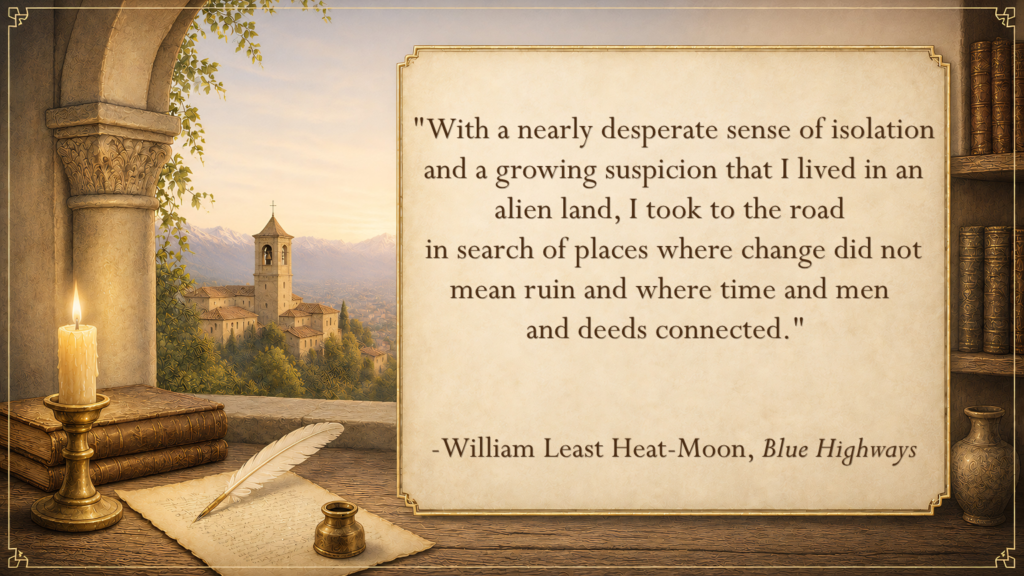
But I had almost no one to share it with. The friends who might have understood were in louder, more contemporary churches, or in no church at all. The people who already understood were several decades ahead of me, and the road they remembered ran through their time, not mine. So I stood holding something ancient and true, with no one nearby at the right place on their own journey to receive it.1
It was at a Stations of the Cross service that I stopped being the communications director for a moment and became something simpler.
He was a World War II veteran, a regular member of the congregation, somewhere in his nineties. He had dressed in his alb for the service and volunteered to lead one of the stations. The Stations move around the sanctuary in sequence, fourteen moments of the Passion, each requiring a short liturgy read aloud at each stop. It is a slow service by design. The slowness is the point.
He was in severe back pain that day. You could see it in the way he moved between stations, the particular speed of someone negotiating with a body that has its own terms now. When he read, his voice broke in places. There were tears on his face, and for a while I could not tell whether they were from the pain or from the words, and then I understood that the question was beside the point. He steadied himself and kept going.
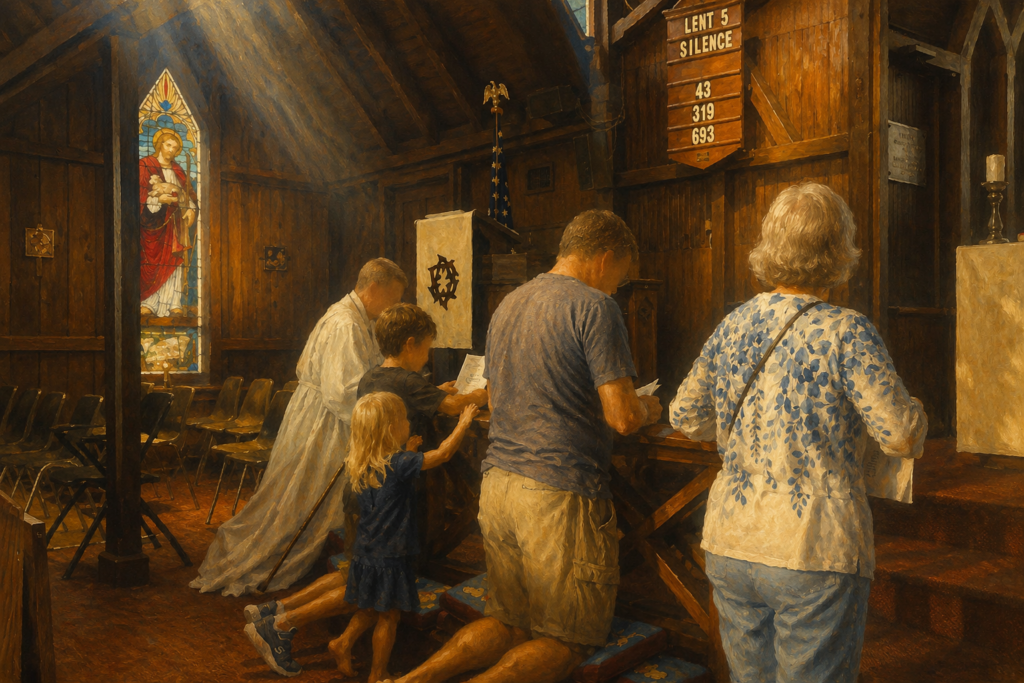
At the final station, he knelt at the altar rail. My son knelt on one side of him, and my daughter next to him. The sunlight coming through the stained glass had that mid-day clarity and brightness that overcomes the space. The Crown of Thorns banner hung on the lectern, carefully placed by a member of the Altar Guild, with whom I had also spent a season helping out. The hymn board read Lent 5, Silence. The hymn numbers were 43, 319, 693.
He bowed his head.
A few days later he sent me a message. He said he was so sorry for his leadership during the Stations. He had been in severe back pain. ‘The children could have read better than I did’, he noted. He felt he was a burden to the church. He had thought he could beat the odds of the pain that day, and perhaps he should instead ‘just sit back in the pews now and listen’ to the Word of God.
I read it twice.
Then I wrote back and told him not to apologize in any way, in any shape, in any form. That it went as exactly as it was supposed to go. That it was an honor to have been there with him. That what my children had received by kneeling beside him at that altar; watching someone who had been returning to the same liturgy for seven decades still show up, still be moved by it, fighting through the cost of being present because it was in his heart to participate- was something no curriculum could produce and no program could generate.
He thought he had failed a performance.
What he had actually done was show my children what the seventh decade of faithful return looks like. What it looks like to bring your aging body back to the same kneeler, to let the words that have been shaping your whole life continue their slow work, even when the pain makes it hard to stand. He was not carrying the whole church alone. He was not pushing faster than the institution could receive. He was simply showing up, within his limits, at cost, because it was in his heart to participate.
That is what I had spent two years trying to generate by myself.
You cannot generate it.
You can only witness it, and return.
The second turn through my labyrinth revealed the second rule:
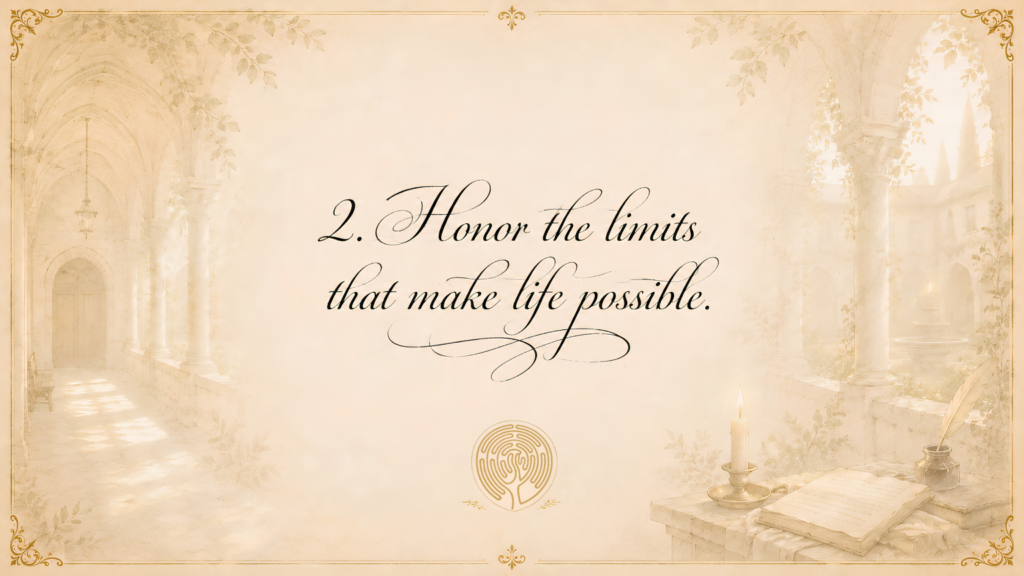
The unsustainable will end. It’s better to choose the ending than to have it chosen for you. When one is weary, let the others bear the burden. Coffee may assist.
The Strategic Disciple is a reader-supported publication. To receive new posts and support my work, consider becoming a free or paid subscriber.
This piece is part of the Breaths series. It works best read in order, beginning with Breath I: A Good Light
Explore the larger project:
TheStrategicDisciple.com — Quiet enough to be felt
LiturgicLabs.studio — Faithful imperfections for the faithfully imperfect
Ko-Fi — The tip jar to keep the coffee press going
© 2026 The Strategic Disciple, LLC. All rights reserved.
1 Least Heat-Moon, W. (1982). Blue highways. Fawcett Crest.