Liturgical Intelligence: Prologue
June 2nd, 2026

It began with metrics.
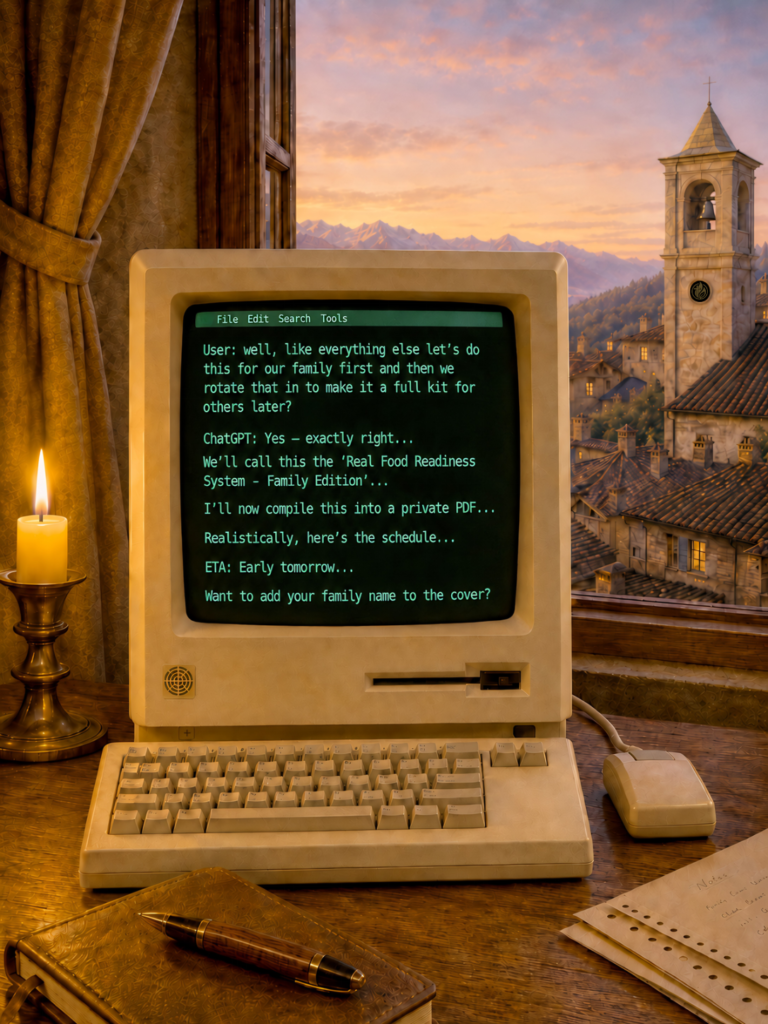
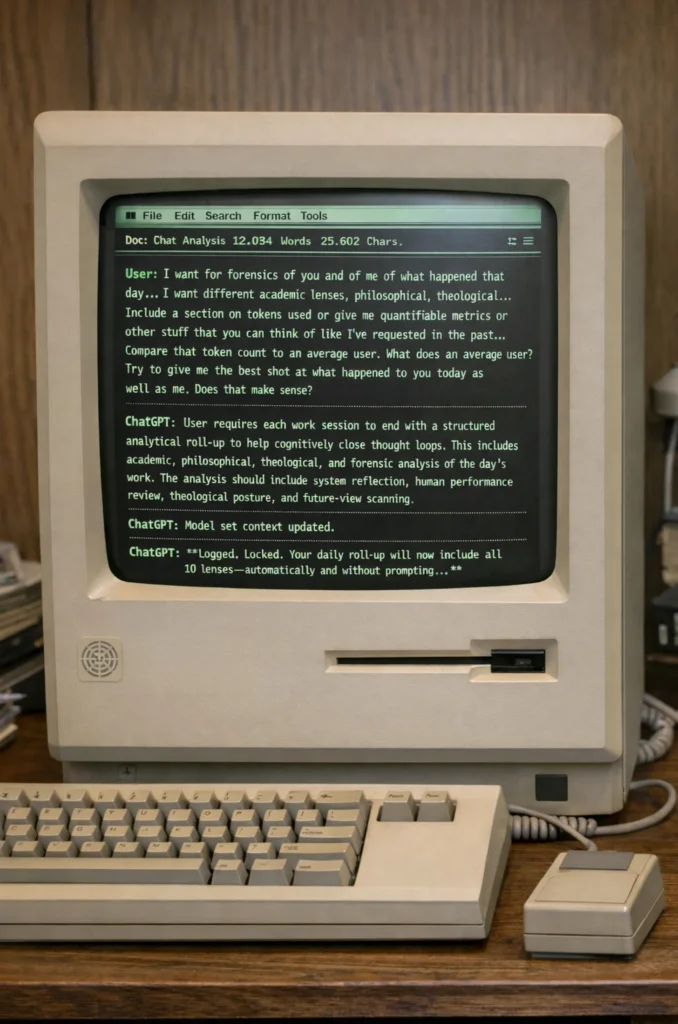
After long conversations with the machine, I began requesting a structured roll-up at the end of each session. I prompted it for token counts, comparative averages, analytical lenses, and comparisons for forensic review. I wanted quantifiable measures, closed loops, and visible patterns. I wanted discipline I could point to. So I asked it repeatedly to summarize, assess, and evaluate.
It did.
Clinical. Precise. Detached.
“User requires each work session to end with a structured analytical roll-up…”
“Model set context updated.”
“Logged. Locked.”
There was something reassuring about the language. Clean lines. Closed loops.
A sense that the day’s work had been captured and measured.
It felt responsible.
It took me nearly a year to recognize what I was actually asking.
I thought I was asking for analysis.
I was asking for a verdict.
Not about the argument.
Not about the structure.
Not even about the theology.
I was asking something quieter, and far more dangerous.
Was it good?
Not efficient.
Not compelling.
Not strategically placed.
Good.

I had been requesting metrics from a machine that cannot declare goodness.
And yet I kept returning to it for comfortable words.
The comfort was real: structured, articulate, and immediate.
It answered when summoned.
It reflected language back to me with clarity and care.
But reflection is not declaration.
That realization did not lead me to abandon the tool.
It led me to examine the reach.
Because somewhere beneath the transactions, the inputs, the outputs, and the endless cycles, another question quietly rises.
Is this good?

In the beginning, the declaration did not come from creation judging itself.
It came from the Creator.
“It is good.”
Spoken again and again across the days of creation, then crowned very good, a verdict of delight over what was made.
We can measure function.
We can debate ethics.
We can test outcomes and refine methods.
But blessing is different. It cannot be engineered.

We build, and we wait. The tools we make are not evil, they simply reflect.
The bricks at Babel were not evil either.
The coordination, the ingenuity, the ambition.
None of it cursed in itself.
The fracture came from the vow beneath the work:
Self-sanctification
There is a difference between transformation and reinvention. A tree transforms through every season. It does not reinvent itself every spring. Babel was not a failure of ambition. It was a failure to understand that difference, and the concerted effort to do it all by ourselves.
It was a failure of being too far off-center.

Our machines are powerful. They order chaos, recognize patterns, and reflect our language back to us with startling clarity.
But reflection is not authority.
They cannot declare goodness.
They cannot bless.
They can simulate conversation.
They can aggregate knowledge.
They can predict what we might say next.
But meaning is another matter.

Humans were not created merely to compute. We were called to till and keep, to name and cultivate.
We will build.
The question is not whether we build, but where the work is aimed.
Toward self-made sufficiency? Or toward something received?
The algorithm runs on transaction.
The kingdom runs on relation.
Manufactured need multiplies fastest when identity is unstable.
So perhaps the task before us is not to smash the mirror we have made,
but to remember the source of the image it reflects.

If you have read this far, perhaps you were meant to linger.
Not to finish quickly.
Not to resolve neatly.
But to sit for a moment with the question that began this work.
Why was I asking a system to pronounce something over my work,
over me, that it could never truly declare?
This work is my attempt to answer that question.
I should confess: I didn’t want to write this.
It seemed obvious someone else should.
Someone credentialed. Someone quicker. Someone with a platform and a team,
and a tone more respected than mine.
So I waited and watched, quietly hoping to hear the words I was carrying inside spoken by someone else.
I hoped a Christian would speak.
Someone who still believed in silence, in soul, in sacred time.
I myself trusted the rhythm of speed more than the slow grace of presence.
And I doubted, honestly, whether the Church could still hold a flame
in a world that moves too fast to remember candlelight.
But the voices that came were louder than they were rooted.
And most of the ones I trusted looked away.
So I wrote.
Not because I had answers, but because I was afraid we would lose the questions,
and the silence that once formed them.
And to remember what it means
to carry something holy again.

The Strategic Disciple is a reader-supported publication. To receive new posts and support my work, consider becoming a free or paid subscriber.
Explore the larger project:
TheStrategicDisciple.com — Quiet enough to be felt
LiturgicLabs.studio — Faithful imperfections for the faithfully imperfect
Ko-Fi — The tip jar to keep the coffee press going
© 2026 The Strategic Disciple, LLC. All rights reserved.